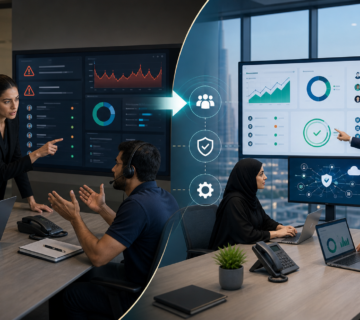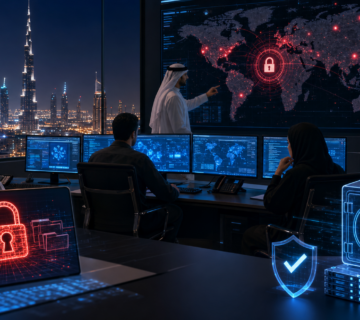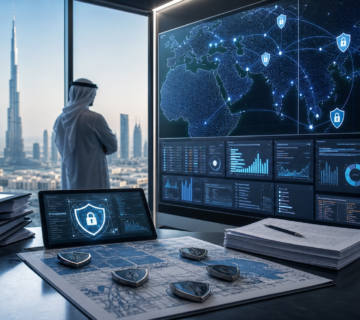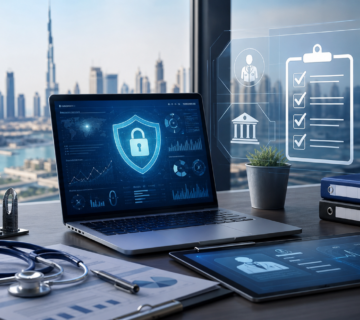
UAE cybersecurity warnings in 2026 are sending a clear message to Dubai businesses: cyber risk is no longer limited to large government entities or global enterprises. Phishing, ransomware, data leaks, state-backed threat activity, and AI-assisted social engineering are now business continuity issues for organisations of every size.
Recent public warnings from the UAE Cybersecurity Council and UAE media coverage point to a more aggressive threat environment. The Council has highlighted ransomware attempts against strategic sectors, the continued rise of phishing and social engineering, and the growing use of AI-powered attack methods. Aletihad also reported that 71.4 percent of tracked cyber threat groups targeting the UAE were state-sponsored or advanced persistent threat groups, with 128 confirmed incidents recorded since the beginning of 2026.
For Dubai companies, this is not a headline to read and forget. It is a signal to review email security, identity protection, endpoint controls, backups, vendor access, and incident response before a small gap becomes a costly disruption.
Why The 2026 UAE Cyber Threat Picture Matters
The UAE is one of the region’s most digitally advanced economies. Dubai businesses rely on cloud platforms, online payments, remote access, CRM systems, SaaS tools, WhatsApp communication, Microsoft 365, and connected operations. That digital maturity creates speed and scale, but it also increases the number of places attackers can target.
Threat actors do not need to break every system. They often need only one weak password, one untrained employee, one exposed remote access tool, one unpatched server, or one vendor account with excessive permissions.
This is why the current UAE threat picture matters. The attacks being discussed are not abstract. They map directly to the systems most businesses use every day.
Phishing Is Still The First Door Attackers Try
The UAE Cybersecurity Council has warned that a large share of cyberattacks begin with phishing emails. Public reporting in April 2026 also noted the massive global scale of scam messages and the growing role of AI in making fraudulent communication more convincing.
For Dubai businesses, this changes the old phishing playbook. Staff can no longer rely on obvious spelling mistakes, strange formatting, or suspicious grammar as the main warning signs. AI-generated messages can imitate tone, urgency, vendor language, invoice formats, and executive communication far better than older scam templates.
Practical actions:
- Enforce multi-factor authentication for all email and cloud accounts.
- Block legacy authentication where possible.
- Train employees on invoice fraud, QR phishing, and fake file-sharing alerts.
- Add external sender warnings for email.
- Review mailbox forwarding rules every month.
- Use advanced email filtering and impersonation protection.
The goal is not to make every employee a security analyst. The goal is to reduce the chance that one click becomes a full business compromise.
Ransomware Risk Is Now A Resilience Test
The UAE Cybersecurity Council has also reported successful action against ransomware attacks targeting strategic sectors. For private companies, the lesson is direct: ransomware defence is not only about blocking malware. It is about whether the business can continue operating when systems are disrupted.
A Dubai company should be able to answer three questions.
First, can we detect unusual activity quickly?
Second, can we isolate affected systems before the attack spreads?
Third, can we restore clean data without paying attackers?
If the answer to any of these is unclear, the business has a resilience gap.
Practical actions:
- Keep offline or immutable backups for critical systems.
- Test backup restoration, not just backup completion.
- Patch internet-facing systems quickly.
- Use endpoint detection and response on workstations and servers.
- Segment networks so one compromised device does not expose everything.
- Prepare a ransomware response checklist before an incident occurs.
Ransomware recovery is much harder when decisions are made for the first time during a crisis.
State-Sponsored Threat Activity Raises The Bar
When advanced threat groups target a country, businesses need stronger assumptions about risk. Even if a Dubai company is not the direct target, it may be connected to a target through supply chains, client relationships, cloud services, professional services, or managed vendors.
This is especially important for companies in finance, healthcare, logistics, energy, construction, legal, real estate, and technology services. These sectors often hold sensitive data, transaction records, customer documents, infrastructure details, or privileged access to client systems.
Practical actions:
- Audit administrator accounts and privileged access.
- Remove unused accounts and dormant vendor access.
- Require conditional access policies for cloud systems.
- Monitor risky sign-ins and impossible travel alerts.
- Document which vendors can access sensitive data.
- Review cyber insurance requirements against actual controls.
The businesses that handle this well do not wait for a breach. They maintain evidence that controls are in place and working.
AI-Powered Social Engineering Needs New Defences
AI has lowered the effort required to create believable phishing messages, fake support conversations, synthetic voice calls, and tailored business email compromise attempts. Attackers can now personalise scams using public company information, LinkedIn profiles, leaked data, supplier names, and recent business events.
Dubai businesses should assume that future fraud attempts will look more polished, more contextual, and more urgent.
Practical actions:
- Require callback verification for bank detail changes.
- Use approval workflows for payments and vendor onboarding.
- Train finance teams on executive impersonation.
- Protect Teams, WhatsApp, and email workflows from social engineering.
- Review whether sensitive internal documents are publicly exposed.
- Run simulated phishing exercises that reflect real business scenarios.
Technical controls matter, but process controls are just as important when attackers target human trust.
What Dubai Businesses Should Do This Month
The right response is not panic. It is a focused security review tied to the risks most likely to affect the business.
Start with these actions:
1. Review Microsoft 365 or Google Workspace security settings.
2. Confirm all users have multi-factor authentication enabled.
3. Check endpoint protection coverage across laptops and servers.
4. Test backup recovery for at least one critical system.
5. Review administrator and vendor access.
6. Patch exposed servers, websites, VPNs, and remote access tools.
7. Document an incident response contact list.
8. Train employees on AI-powered phishing and payment fraud.
9. Review cyber insurance control requirements.
10. Create a 30-day remediation plan for the highest-risk gaps.
The best cybersecurity programmes are practical. They identify the most likely business risks, fix the controls that matter most, and create evidence that leadership can review.
How Technijian UAE Can Help
Technijian UAE helps Dubai organisations turn cybersecurity warnings into clear operational action. Our team can review identity security, Microsoft 365 controls, endpoint protection, backup readiness, ransomware resilience, compliance gaps, vendor access, and incident response planning.
If your business has not reviewed its cybersecurity posture in the last quarter, now is the right time. The 2026 UAE threat environment demands stronger preparation, better visibility, and faster response.
Book a Technijian UAE cybersecurity readiness review to identify your highest-risk gaps and build a clear action plan.
FAQ
1. What is the biggest cybersecurity risk for Dubai businesses in 2026?
Phishing remains one of the biggest risks because it can lead to credential theft, invoice fraud, ransomware, and data exposure. AI-generated messages make phishing harder to detect, so businesses need both technical controls and employee training.
2. Why should small and mid-sized Dubai businesses care about UAE cybersecurity warnings?
Attackers often target smaller businesses because they may have weaker controls, fewer IT staff, or less mature incident response plans. A smaller company can also be attacked through suppliers, cloud accounts, payment workflows, or exposed remote access systems.
3. What should a company check first after reading a cybersecurity threat report?
Start with identity security, email protection, endpoint coverage, backups, administrator accounts, vendor access, and incident response contacts. These areas usually reduce the most practical risk quickly.
4. How often should Dubai companies test backup recovery?
Critical backup recovery should be tested at least quarterly, and more often for systems that support revenue, operations, finance, healthcare, or customer service. A backup that has never been restored is only an assumption.
5. Can Technijian UAE help with ransomware and phishing readiness?
Yes. Technijian UAE can assess Microsoft 365 security, endpoint protection, backup posture, access controls, phishing exposure, and incident response readiness, then create a prioritised remediation plan.